
In some ways, schools and education systems in the 20th Century have changed dramatically. In the US, the industrial revolution contributed to the rapid emergence of comprehensive high schools which expanded educational opportunities for many students. In the 1960’s, Singapore began creating a comprehensive public education system out of a disparate set of English, Chinese, Tamil, and Malay schools that previously served only a small portion of the population; and in the 1970s, Finland turned a highly inequitable and inefficient group of schools into a comprehensive school system that offered a consistent, high-quality education to all students.
Despite these developments, over the last thirty years, my studies of the ambitious efforts to transform these and other education systems, demonstrates that once established, even “high performing” education system are extremely difficult to change. As a consequence, even educators and policymakers in places like Finland and Singapore are still working to figure out how to transform education systems so that they support deeper learning, address 21st Century skills, and foster the development socio-emotional abilities and wellbeing.
In order to address this critical challenge, in this project I’m applying what we’ve learned about the failures of ambitious reform efforts in the 20 th Century to explore how we can transform education in the 21st Century. This work builds on several key principles of school improvement I described in The Education We Need for a Future We Can’t Predict. Those principles suggest:
- New possibilities for schooling are most likely to take off when their goals, capacity
demands, and values fit the common needs, existing capabilities, and prevailing conditions
in the schools and communities where they are supposed to work; - But the more radical visions for educational reform are, the less likely they are to fit the
affordances of conventional schooling and to take hold on a large scale - Nonetheless, the demands and pressures of conventional schooling make it easier to
bring radical visions to life in particular circumstances and contexts – ecological “niches” of
possibility” – rather than across entire school systems.
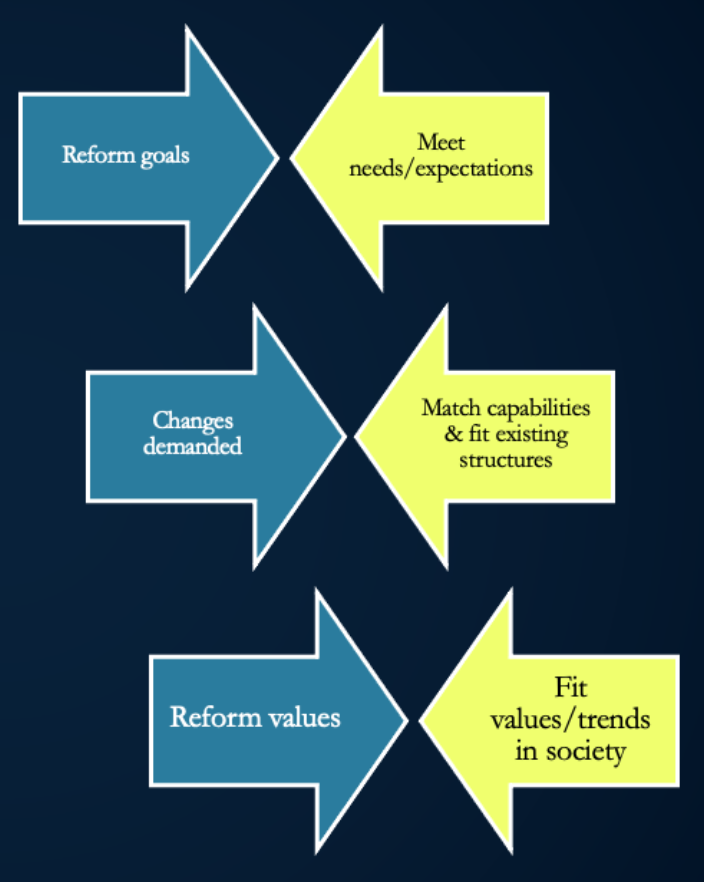
This “niche” approach suggests a shift away from a focus on creating new educational practices – such as more holistic, personalized or student-centered approaches to learning – that are supposed to work in general, for all subjects and topics, all the time. Instead, a “niche” approach focuses on developing specific “micro-innovations” and adaptations – resources, structures, practices services and activities that are new to the contexts in which they are introduced.
To explore the policies and practices that are most likely to lead to real improvements in learning in different contexts, I will be interviewing educators, policymakers, and researchers in several different education systems including Finland, Estonia, Singapore and Vietnam. I focus particularly on these four because Finland and Singapore are well-established high performing education systems that are working to shift from a focus on conventional academics and exit exams to a focus on 21 st Century skills and support for students’ overall development and well-being. Estonia and Vietnam have emerged as high-performing education systems more recently and are already shifting to a focus on competences. I hope to extend this study for comparison to several other education systems including those in Iceland, China, and South Africa.
Through this project, I will be documenting some of the most promising innovative educational practices and comparing how they have evolved and grown in their local context. Although I am interested in educational innovation in general, I will be looking particularly for promising educational developments and “micro-innovations” in several areas which are most likely to take off in the next few years. These include developments in the teaching of academic subjects using technology and artificial intelligence; in support for students’ mental health and well-being; and in the sustainability of school facilities and operations. This work will serve as the background material for my next book that will explore what is and is not changing in education both inside and outside schools in the 21 st Century.
 Thomas Hatch