Tag Archives: travel

Fostering collective responsibility for inclusive education: Developing national support for immigrants and multilingual learners in Iceland (Part 2)

Learning materials, language support, and cultural mediators, these are a few of the elements of Iceland’s efforts to create a more welcoming and inclusive education that Fríða Bjarney Jónsdóttir discusses in the second part of this interview. In the first part of this conversation with Thomas Hatch, Jónsdóttir outlined some of the first steps Iceland has taken to establish their national approach. Jónsdóttir works as a specialist at the Ministry of Education and Children coordinating the MEMM project an abbreviation for education, welcoming and culture. The project  is being developed in close collaboration with the Centre for Language and Literacy in Reykjavík and the newly established national Directorate of Education and School Services. Previously Jónsdóttir was the head of the Center for Innovation at Reykjavík’s Department of Education and Youth and before that served as a coordinator for multicultural education in preschools. For earlier coverage of developments in Iceland’s education system see part 1 and part 2 of a conversation with Jón Torfi Jónasson “On the inertia of education systems and hope for the future” and “Relish the freedom you have and find the balance.”

++++++++++++++++++++++

Thomas Hatch: You’ve talked about some of the major initiatives you’re pursuing now including the collaboration around the data system, the production of resources and curriculum for inclusive education, and the development of a group of cultural mediators who can help educators and schools address the needs of immigrant families. But what about the challenges? What are some of the issues you need to deal with in order for your work to be successful? 

Fríða Bjarney Jónsdóttir: One of the issues is that Icelandic is a really tiny language. It doesn’t have much global value. As a result, you might have parents who’ve been living in Iceland for years and years without learning Icelandic. They could be working in the tourist industry, for example, but the company owners don’t care whether their staff speak Icelandic or not. There is a policy to support the learning of Icelandic as a second language, but it’s not acted on, and everyone needs to take responsibility for that. 

We need to provide an Icelandic learning community to support learning the language, and one way we are trying to do that is through continuous education. In almost every corner of Iceland, you have a center where you can go and you can learn all sorts of things, including instruction in Icelandic. But there’s no standardized syllabus, and we don’t have standardized learning material. 

TH: So that’s part of the reason you are trying to create the resources and materials for more effective instruction for Icelandic as a second language? 

FBJ: Yes, we’re doing that for the pre-primary, primary and secondary levels, but ideally it would happen for continuing education as well. It should happen at all levels. Just to give you an example, I was in a municipality where almost 70% of the children in the schools have an immigrant background. I told them, “Okay, you want us to do something about the schools and the education of the children, but what is the welcoming plan of the municipality? How do you welcome newcomers into your municipality?” This can’t be just about the schools.  There has to be a plan for how the community welcomes newcomers that includes both the municipality and the schools. 

Reykjavik has that kind of plan. The idea for their welcoming plan actually started in the Reykjavik Youth Council. That Council includes kids who are 14 to 18, and they can create proposals and appeals for the City Council to consider. They participate in one meeting with the City Council to put their ideas forward, and the City Council accepts some of the appeals.  The ideas that are accepted are sent to the relevant department, like the city’s Department of Education and Youth or the Department of Welfare. 

Back in 2015, I was leading the multicultural team at the Department of Education in Reykjavik, and the Youth Council introduced this idea about how the neighborhood could welcome newcomers. I thought it was so interesting that the youth council was bringing this up, so I called them all in and said “I want to hear the story behind your idea.” This guy who was already in upper secondary school, I think he was 17 at the time, said he was Icelandic, and he was living in a neighborhood in Reykjavik, where you have the most immigrants. “I’ve been in the same school for 10 years,” he told me, “and I’ve been having kids coming in my class every year that don’t speak Icelandic. For many, many years, I was with the same boy from Poland, and no one taught me how to talk to him. I feel so guilty about that, and I wanted to do something about it.” That was the beginning. Now there is a collaboration between the schools and a service center in the four districts of the city. This approach has been implemented in all the districts in Reykjavik, but it’s not something that’s happened nationally. One service center situated in the most diverse district has  “ambassadors” that have been appointed from about 9 or 10 immigrant groups. The ambassadors act as consultants to the service center to help them improve their services, and they serve as a link to the immigrant groups in the district. There are some municipalities, like, the municipality closest to the airport where they have been doing wonderful work, that we can all learn from, but it’s not exactly the same in each place. 

I also remember this wonderful welcoming plan that was in the East fjords some years ago where they had a welcoming person who met all new families. It didn’t matter where they came from, she met all the new families a few days after they moved to the town; gave them a card for the library, visited the pool, showed them where the social services were, and took them to the schools.  Now, when I visit other places, I point out to them that you cannot do this in isolation, and you can build on these examples from Reykjavik and these other municipalities.  

TH: You’ve talked here about welcoming immigrants, but in many cases, with refugees in particular, you’re welcoming people who’ve experienced trauma. How have you addressed that?

FBJ: This is something that we are learning little by little. I know in the US you have had trauma sensitive education and other initiatives that we have not had here, but it’s coming. We have a project we are working on now, Heillaspor that’s nationwide for Icelandic schools. It’s based on a Scottish project called Nurture. That’s an inclusive trauma sensitive project based on attachment theory: How do you build relationships and connections between adults and children? Between the children themselves? Between children and families? Between families and schools? And how can you support teachers in protecting themselves, their emotions and feelings so that they become less fragile in difficult situations? 

Heillaspor (Nurture), Directorate of Education & School Services

But we also have some local projects. One that I have visited is developing micro-initiatives to support children and families who having huge challenges, in terms of finances, parents with drug addiction, children not going to school and all that. One of the initiatives that they are implementing, is called SPARE (It stands for supporting parents among refugees in Europe). They provide a 12-week program for parents with a refugee background and provide clinical therapies. 

TH: Are there any other major challenges that you’re facing? 

FBJ: There are so many challenges! The dominance of English is another challenge for teaching Icelandic as a second language. English is almost the lingua franca in Iceland so there’s a fight to keep the Icelandic language alive. My background is in multicultural, multilingual pedagogy, so when I’m working with multilingual children and families, I build on the strengths and resources that they bring to the school. For example, I will try to activate their languages while teaching them Icelandic. I will try to learn about our similarities and our differences. But that’s becoming a challenge because English is the language that everyone is using, so, for many teachers, it’s easier to speak English to newcomers. Teachers who are responsible for teaching Icelandic as a second language only work with a child for a few hours a week outside the regular classroom, and there is not a focus on building relationships through Icelandic with the classmates. As a result, there is a danger that the  child goes back into the regular class and never practices Icelandic. That’s why we are also trying to change attitudes and beliefs and make it clear that learning Icelandic as a second language is a joint responsibility of the whole school not only the appointed second language teacher. 

But this work has to deal with the increased racism, hate speech, extremism, and polarization that you are seeing in the US and Europe as well. This certainly makes it difficult when you want to work in an inclusive way with cultures and languages. As one example, I gave a course for all the head teachers of preschools in one of the neighborhoods in Reykjavik. I talked about attitudes and beliefs and what inclusion means. What does it mean to be culturally sensitive? They did all sorts of projects and discussions about this, because you can provide all sorts of material and support, but if people don’t work with themselves and their own beliefs and attitudes, things hardly change. We see this as a huge, huge, huge challenge. This is an issue everywhere, but at least the policy here is in favor of multilingualism and multiculturalism. 

The education of teachers is another huge challenge. Icelandic society has changed very, very fast, and teacher education is struggling to keep up with the pace of societal changes. We don’t have a good knowledge of how to teach Icelandic as a second language, for example. We have to build up that knowledge, and we also have to build up the knowledge of culturally and linguistically sensitive practices and our projects are trying to contribute to that. 

TH: Is there anything that’s been successful in working on teacher education? Any area where progress is being made? 

FBJ: There are some good initiatives at our universities for teacher education, and you have teachers that really want to change things. We are working with many different groups, including representatives from the universities, the teachers’ union, the Association of Municipalities, and we are having meetings about teacher education. You could say, we have “opened the mic.” There is also a recent book about teacher education in the Nordic countries when it comes to multilingual children, and there are two chapters about teacher education in Iceland (Teacher education for working in linguistically diverse classrooms: Nordic perspectives). 

TH: All this gives us a great sense of the initiatives you’ve gotten started. Is there anything else that you see coming down the line or that you’re hoping to get going as next steps? 

FBJ: We have less than year to go with this project, and it’s supposed to finish with a draft for the parliament that describes what we want support for school services and support to the municipalities to look like. At the same time, I hope we would get some kind of a consensus between the state and the municipalities:  What is the responsibility of the state? What are the responsibilities of the municipalities? And how are we going to divide the cost? This work has been going on for a while. I think that now we know the challenges. We know what we have to do. We have a lot of resources, but we need this collaboration, and we need a systemic approach so we can work on this together. 

Part of what I’m trying to do during these two years is influence attitudes and change how people view working with culturally and linguistically diverse groups of children so everyone sees that it’s not a matter of fixing someone; it’s not a matter of a single teacher being responsible. We as a society are responsible for building on the resources that people bring and providing them the education they need to live here. That’s where I would like to see us.

Bringing a Tablet-Based Foundational Learning Program to all the Primary Schools in Malawi: Joe Wolf and Kira Keane on the Evolution of Imagine Worldwide (Part 1)

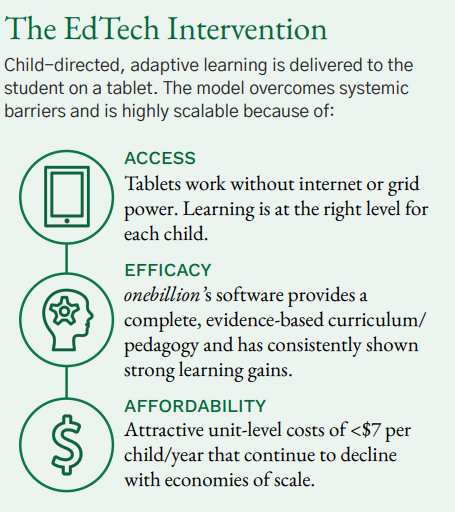
What does it take to scale a tablet-based foundational learning program to all the primary  schools in Malawi? In this 3-part interview, Joe Wolf and Kira Keane describe how Imagine Worldwide has approached that challenge and share some of what they have learned in the process.  The tablet-based program at the center of Imagine Worldwide’s work, developed by software partner onebillion, serves as a supplement for regular instruction, with each child in a school spending a targeted 150 minutes per week working independently on problems related to reading and mathematics. Imagine Worldwide partnered with the Government of Malawi to rollout the program in 500 primary schools in 2023-24, with the ultimate goal of expanding to all 6000 primary schools in Malawi, serving 3.8 million learners in standards [grades] 1-4 annually. Joe Wolf is the Co-CEO and Co-Founder of Imagine Worldwide and Kira Keane is the Director of Communications. (Photos/graphics are from Imagine Worldwide unless otherwise noted.)

TH: Can you describe for us some of the key steps or phases you went through as you developed your work to test and then to scale-up this tablet-based program in Malawi? 

Joe Wolf: The first phase of our work was all research oriented. We wanted to see if these learner-centric tablet models could work – were they really effective for children? – before asking under-resourced systems to spend time, energy, and capital on them. That meant we had a prolonged research phase that included nine randomized controlled trials. That was across different contexts, different languages, different implementation models, different countries – really exhaustively trying to prove that these solutions can, in fact, add significant value. 

The second phase was what we call “learning to scale:” What are the processes that need to be done repeatedly well to scale within these contexts? We purposely spread our work out across seven countries, with different implementation models, different implementation partners, different types of structures to really test what needs to be done repeatedly well so that these systems can adopt the work at scale. Then, only in the last three years, we’ve put the pedal down and said, “Okay, I think we’re ready to really think about scaling.” And we were only able to act on scaling thanks to the leadership of the government of Malawi, who saw the learning gains of our pilot programs and saw how this edtech intervention could support their national goals of improving foundational skills.  At that point in 2022, we served around 6000 children, but we increased it to about 700,000 children by the beginning of 2025. That’s a 100x increase in the last two years, which I think is a testament to the scalability of the model, the execution of the team, and the leadership of our government partners. 

TH: What’s the third phase? Implementation? 

JW: I would say it’s scale plus continuous improvement. Now, our research is less efficacy oriented and more implementation oriented. How do we make it better and better and better? To address that, we have four levers we focus on: 

  • Access: How do we serve more and more children and make the solutions easier and easier to implement? 
  • Cost-effectiveness: How do we bring down the recurring costs to be as low as possible? We’ve brought costs down around 75% in the last five years, and we think there’s still room to go. Our key inputs are all highly deflationary, so we’re getting better economies of scale as we grow. Right now, we’re at about seven dollars (USD) per child per year. We think we can get that under five dollars (USD) as we get better economies of scale. 
  • Advocacy: How do we use data to improve the implementation model in the software so that the efficacy of the program continues to go up and up and up? It’s one of the beauties of technology that it can iterate and improve. You’re not building a building and putting in books and then five years later it’s deteriorated. We actually have the ability to use data to continuously improve through this flywheel of innovation.
  • Sustainability. How do we work with our government partners to build operational and financial sustainability?  And how do we do it starting day one, where we’re building the “muscles” within the existing education system, as opposed to the classic approach of starting off outside the system and then trying to hand it off to the system. Too often, if you haven’t done a good job of building that internal muscle, and then things fall apart. So we’ve really taken the system strengthening approach, acknowledging that there are capacity and infrastructure gaps within the countries where we work and that there are key functions that need to be built that don’t currently exist within some of these systems. We’ve tried to give it time so that, by the end of the implementation phase, the system has already been doing the work for an extended period of time. That way, you don’t have this fall off as you try to hand-off everything to the system itself.

Kira Keane: I just want to underscore a couple of points that Joe made. For Imagine, this notion of the continuous improvement loop, it’s not like we did things, something went wrong and we’re like, “Oh, we have to fix this.” This was an intentional design element from the very beginning: How do we get continuous feedback to improve both the software itself and the implementation model? And the other point is that our key question is “How do we serve as many children as possible?” The need is so immense and the population growth will be so intense over the next 10-15 years so we really need to be focused on scale. That means working with our government partners to aim for generational impact, really looking at country-wide scale, and focusing on how we design for that.

JW: I’ll add two more things to what Kira said. The ecosystem is exhausted by pilots – by small things that don’t scale, that don’t have evidence, that take a lot of time and resources. Scale from day one very much aligns with where the governments are. They have a big problem with the lack of foundational learning among their students, and they need big solutions. Little, tiny things are just distracting and take too much time and energy. The second thing is that we have positioned our organization to be temporary in nature, so our job is to put ourselves out of business as quickly as we possibly can. We don’t see these as “Imagine Worldwide” programs in Malawi or “Imagine Worldwide” in Sierra Leone. These are programs of the government in Malawi and of the government in Sierra Leone that we are helping to support. We’re helping to build capacity and infrastructure to build muscle within the systems. But as soon as the government is ready to maintain this on its own, we are more than pleased to step out of the way and to move on to the next challenge. I think that positioning is really important for the governments. It’s really important for the funders. It’s really important for us and our team. Too many times, an NGO establishes itself and 50 years later, the NGO is still there, doing the work. We need this work to be sustainable within existing systems. Part of that is a commitment for us to get out of the way. We have to believe in sovereignty and the power of governments to run themselves, while also acknowledging that the use of technology in a place like Malawi is new, and so there is going to be a period of time where we have to build some functions that do not currently exist.

TH: That certainly resonates with my experiences in the US where we’ve seen multiple improvement efforts collide in schools in ways that can actually undermine their capacity for improvement. What made Malawi a good context for you to work on scale-up?  

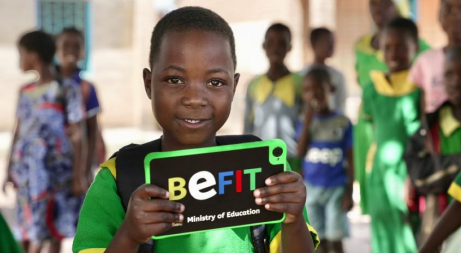
JW: The work in Malawi actually predates the partnership with Imagine. There was a program called “Unlocking Talent,” with the software developer onebillion that became our partner. The onebillion CEO went to Malawi, I think, 15 years ago, fell in love with the country, and developed the product. The first product they developed was in Chichewa, in Malawi. In other words, this was not developed in the West and then adapted to the context. This actually was developed within the Malawian context. We became a research partner to look at impact and to help do the RCT work. That has now evolved into a much more scalable model that we call the BeFIT Program. It’s serving standards [grades] one through four, whereas the first program was only standard two. 

Key elements of the BeFIT program in Malawi

There have been a whole bunch of iterations along the way to develop our general approach, but it basically evolved by thinking about what it would take to actually scale the program much more cost effectively to many more students in more systems. If you look at the other places that we worked, you’ll see that we started with finding local partners, mostly local NGOs, some local social-oriented businesses, and then turned over a lot of the functions to those local partners to see what worked in different contexts. From that, we have built a series of centralized functions that we’re now drawing on in our country partnerships, as opposed to having it be completely decentralized. We learned a lot from the initial more decentralized exploration, but we’re now in the process of creating more standardization. Part of scaling depends on acknowledging that you can’t have fifty different bespoke operations. You need to have systems and standards and data systems. When you have 6000 children in Malawi, using a total of 1000 devices, you can do some things by hand; but now we’re trying to serve millions of children in Malawi, with hundreds of thousands of tablets. We now need data driven systems in order to be able to manage that equipment in the field. 

TH: Let’s follow the arc of that evolution in Malawi. What are some of the steps that were crucial to your learning and to the development of the model?

JW: In Malawi, we took seven or eight years to do the research and to get the right level of government buy-in to understand what was working. That included learning things like what’s the infrastructure for the typical school in Malawi? Just to give you the context, that means more than 100 children per teacher and inadequate levels of teacher training. There’s very rarely basic infrastructure in place, so no electricity and certainly no internet connectivity. That’s the reality of the average class in Malawi. So as you think about the components of our model that have emerged the first was what you would call the infrastructure component. We put solar power into all of our schools, addressing questions like: 

  • Where do solar panels go? 
  • How does the solar electricity feed a bank of lithium batteries? 
  • How do the tablets get stored and secured overnight so that they’re charged and they’re safe? 
  • How does all that equipment get distributed to children in a really efficient manner, so that you’re getting as much asset utilization as possible and as much learning time as possible? 

In the end, our research consistently shows that the number of minutes each student uses the content is directly correlated to the level of learning. So we’re addressing these 101 things that need to be done in terms of the infrastructure and operations to maximize that time on task. And that has to take into account that the school day and the school periods are very short in Malawi and you have a lot of children in the classroom. So even just getting kids in and out of a classroom is a lot harder than in many other contexts.

TH: You just described those complexities really effectively, but for those of us who aren’t familiar with the context, can you go into it even more deeply? What does it really take to get a program like this up and running at scale? 

JW: I think that in addition to a foundational learning organization, we are, in a lot of ways, also a supply chain logistics company. Learning gains are still our north star, but the reality is you’re talking about a phase one of BeFIT that involved launching the program in five hundred schools in five months across half of the country of Malawi, including very rural districts. So we have to deal with the logistics of getting five hundred secure storage cabinets into those schools. We have to deal with the logistics of getting 100,000 tablets distributed across those 500 schools and of getting the solar equipment put into 500 schools. That’s a significant operational lift, and you have to approach that with a level of rigor in terms of those key functions, if you’re going to be able to scale, and you’re going to be able to do that on time. And we had to do that on budget in the middle of a huge macro-economic meltdown in terms of currency and raw materials. In the grand scheme of things, once the equipment is in place, kids can get learning very, very quickly. There’s not a huge lift in terms of adult training. There’s not a huge lift in terms of the role of the adult in the model itself; the content has been built to be autonomous, meaning the child can be self-directed. The tablets themselves have been built to be very robust. A lot of enhancements have been made to make the tablet durable. There’s a long battery life so it can be used throughout the day. Every part of the tablet has been built with screws so that a component can be swapped out if something breaks. So every part of the context has been taken into account in order to get that equipment into the field and utilized. This is one of the big learnings: you have to start with the context in mind, and you have to start with the learning objectives in mind. You then make a series of software decisions, and then you make a series of hardware decisions. Too often in education, it goes the other direction, where people buy stuff, but then they haven’t really thought about what’s going to go on the stuff? What’s the training required? What are the charging and security components of it? What is our learning objective at the end of the day? You have to start with learning, move into the context, and think about all the infrastructure decisions that need to be made in order to make that learning possible in that context. 

KK: I think it’s also important to flag that in working on the logistics we included the government from day one. That means things like using the delivery trucks the government already had. Trying to manage that coordination may have been a little slower or less efficient in some ways, but too often people design an implementation model, put a bow on it, and then hand it to the government without including them from inception. 

Next Week: Building the Capacity to Improve and Sustain Foundational Learning Through Government and Local Partnerships in Malawi: Joe Wolf and Kira Keane on the Evolution of Imagine Worldwide (Part 2)