
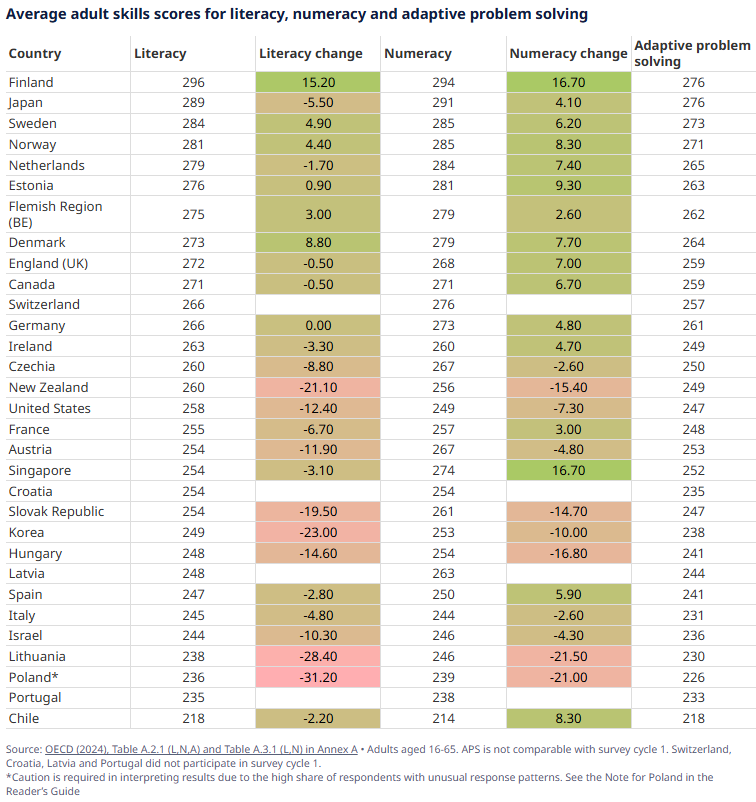
Do adults have the skills they need to thrive in a changing world? That’s the question OECD asks in its report on the results from the 2023 Survey of Adult Skills. In many places, the answer seems to be maybe not. 160,000 16 – 65 year olds in 31 participating education systems took the test and only test-takers in Finland and Denmark improved their scores in literacy, with scores in the other participating systems remaining stable or declining since the data collection began in 2011. 8 of the 31 systems improved in math, but in both literacy and math the lowest-performing adults have shown the biggest decline in scores. Along with the latest scan of the headlines in the education sources we follow, this week’s post provides a brief summary of some of the key take-aways reported. Produced by OECD’s Programme for the International Assessment of Adult Competencies (PIAAC), this estimate of adult skills comes only a few weeks after the latest release of the results of the Trends in Mathematics and Science Survey (TIMSS), which assesses the skills of 15 year-olds (Around the World in Math and Science: Scanning the headlines on the results of TIMSS 2023).
Key Takeaways from the 2023 Survey of Adult Skills
- Finland, Japan, the Netherlands, Norway and Sweden excel in the three tested areas of literacy, numeracy, and problem solving, with significant percentages of adults showing “advanced” abilities.
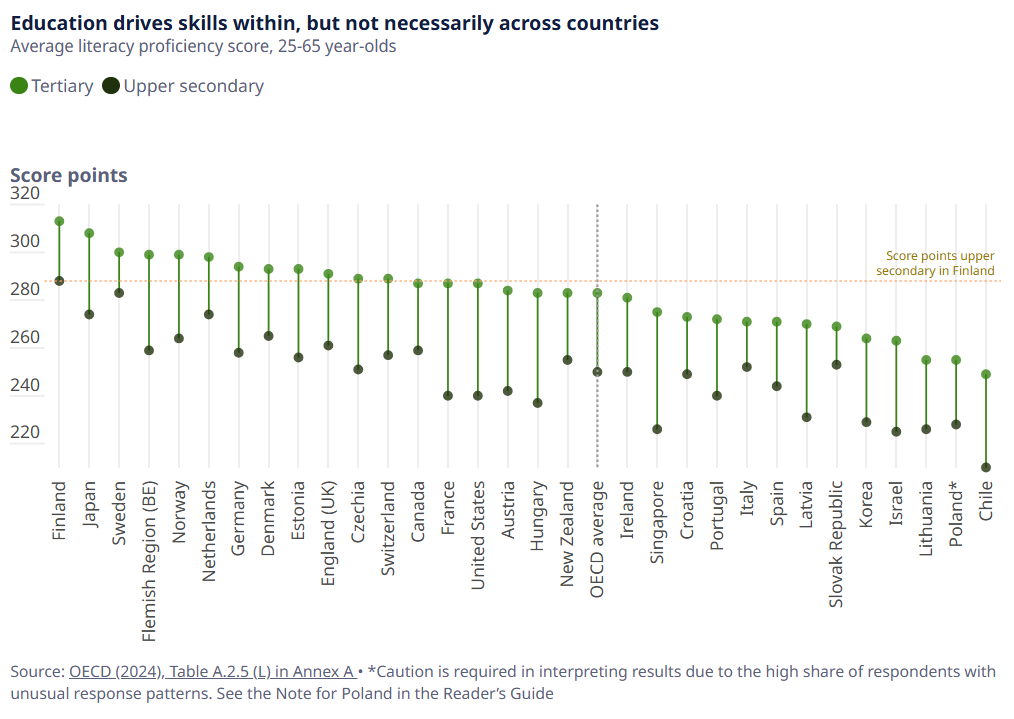
- Finnish high school graduates outperform those with college/tertiary education degrees in several countries, including Chile, Israel and Lithuania.
- Adults who show high levels of skill in numeracy are 11 percentage points more likely to report very good or excellent health compared to those with low numeracy skills
- On average, across participating systems, 18% of adults lack even the most basic levels of proficiency in any of the domains, but the performance of the top 10% has improved, leading to widening skills inequalities within countries
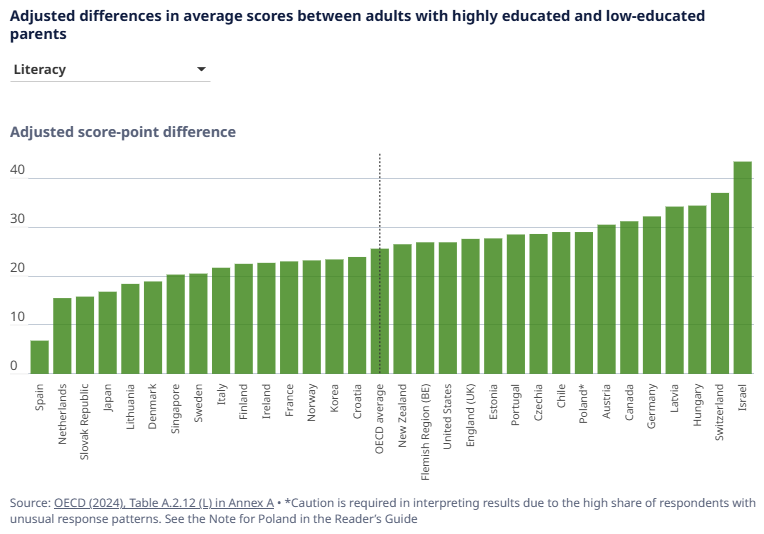
- Adults with highly educated parents outscored those with “low-educated” parents by 50 percentage points in literacy
- Singapore and the United States displayed the largest skills inequalities in literacy and numeracy
- Disparities in educational attainment are largest in Israel, Switzerland, and Hungary (34 percentage points) and smallest in Spain (7 points)
Headlines
Are adults forgetting how to read? The Economist
England
Workers in England more likely to be overqualified than global peers, finds OECD, Financial Times
OECD (PIAAC) Survey: England’s Youth Skills Show Dramatic Improvement Since 2012, FE News
Finland
Finland shines in “adult Pisa” ranking, Yle
Israel
Israeli skills in literacy, math and problem-solving ‘below OECD average’ – report, The Times of Israel
Italy
Italy, a country of functional illiterates, Finestre sull’Arte
Japan
Japan scores high in OECD survey of adult skills, NHK World
Japan again ranks at or near top of survey on adult skills, The Asahi Shimbun
New Zealand
NZ tumbles in international adult literacy, maths rankings, RNZ
Singapore
Singapore improves in OECD ranking of adult skills, but atrophy in literacy a concern, The Straits Times
Spain
30% of Spanish adults do not have minimum skills in mathematics and reading, La Vanguardia
Ukraine
Adults losing edge: Quarter now less skilled than children, RBC Ukraine
United States
In a Test of Adult Know-How, America Comes Up Short, The Wall Street Journal
Survey: Growing number of U.S. adults lack literacy skills, NBC News
U.S. Reading and Math Gap Is Getting Worse for Adults, Too, Education News
 Thomas Hatch